
Starting Point
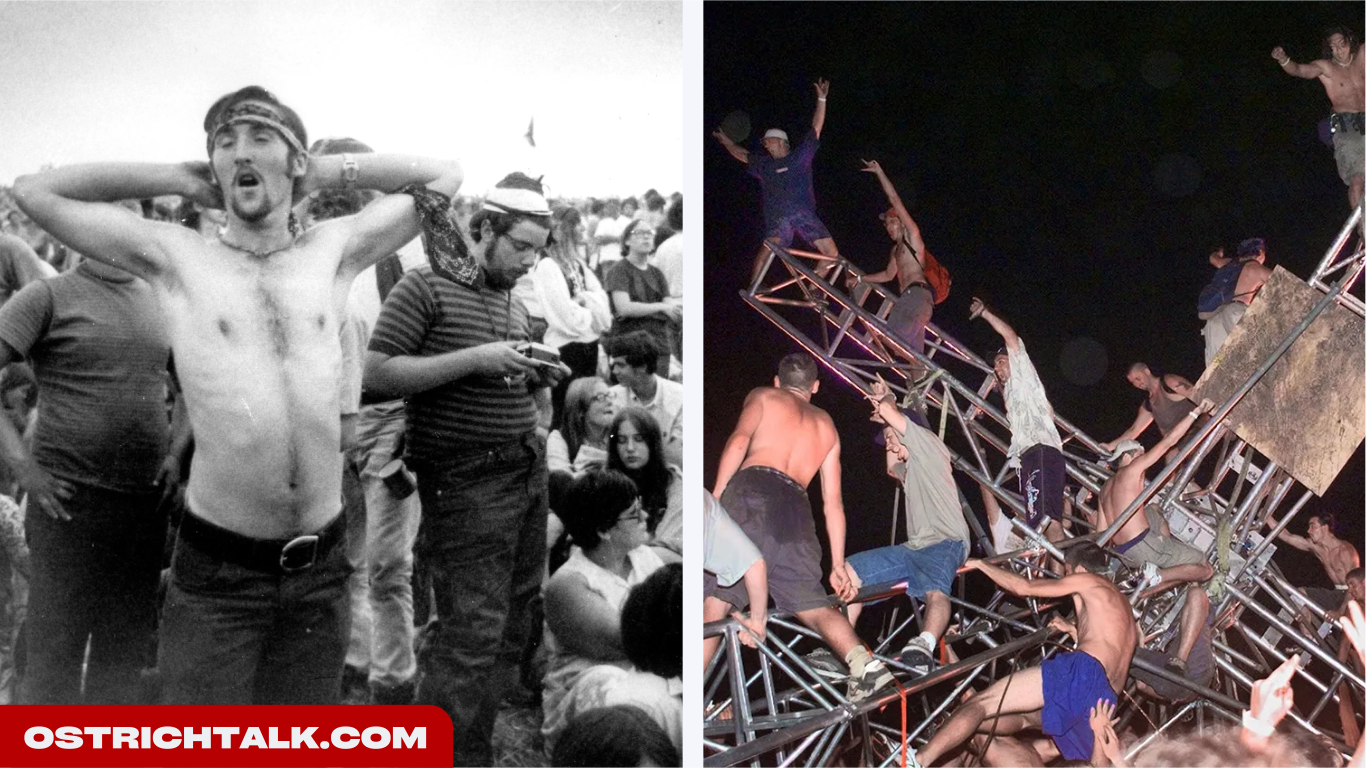
Who is responsible for the Woodstock 99 deaths? It is a question that has haunted the music industry for over two decades — and one that Netflix’s 2022 documentary Trainwreck: Woodstock ’99 brought roaring back to global attention. Furthermore, Woodstock 99 was supposed to be a triumphant thirtieth anniversary celebration of the original 1969 festival — three days of peace, love, and music reimagined for a new generation. Instead, it became one of the most catastrophic events in music festival history. Indeed, riots erupted, fires blazed, sexual assaults were reported en masse, and three people lost their lives. Moreover, 5,162 medical cases were recorded over the weekend by the New York State Department of Health — a staggering figure for a four-day music event.
However, identifying who is truly responsible for the deaths and chaos of Woodstock 99 is not a simple matter of pointing at a single villain. Furthermore, the full picture involves the festival organizers’ catastrophic decisions, the extreme heat and inadequate infrastructure, the charged atmosphere created by certain performers, the failure of security, and a broader cultural moment that nobody in charge was prepared to manage. Consequently, this article covers everything — the three deaths, the main parties responsible, the lawsuits, the Limp Bizkit debate, and the complete 2026 verdict on who bears the most culpability for what happened at Griffiss Air Force Base in Rome, New York in July 1999.
The Three Woodstock 99 Deaths: Who Died?
Three Lives Lost
Furthermore, three people died at Woodstock 99 — a figure that, while small relative to the 400,000 attendees, represents three preventable tragedies that could and should have been avoided. Indeed, each death tells a different story about the failures that converged over that weekend. Moreover, understanding exactly who died and how gives important context to the broader question of responsibility.
The Three Woodstock 99 Deaths Table
| Victim | Age | Date of Death | Cause | Circumstances |
|---|---|---|---|---|
| David G. DeRosia | 24 | July 26, 1999 | Hyperthermia (heat stroke) | Collapsed watching Metallica on Saturday; died in coma 2 days later |
| Tara K. Weaver | 28 | July 25, 1999 | Struck by vehicle | Hit by two cars walking along road after her car broke down leaving the festival |
| Unnamed man | 44 | July 25, 1999 | Cardiac arrest | Died at Woodstock campground; had pre-existing heart condition |
David G. DeRosia
Furthermore, the most directly attributable death to the conditions at Woodstock 99 was that of David G. DeRosia. DeRosia collapsed in the crowd whilst watching Metallica perform on the Saturday evening. He died on Monday, July 26 after being in a coma for two days, from “hyperthermia, probably secondary to heat stroke.” Indeed, heat stroke is a medical emergency that is almost entirely preventable with adequate water, shade, cooling stations, and trained medical response. Moreover, temperatures at the festival reportedly reached 100 degrees Fahrenheit, water access was severely limited, and medical staff were reportedly unprepared for the volume and severity of heat-related illness.
The Medical Tent Failure
Furthermore, the inadequacy of the medical response on site is one of the most damning elements of the DeRosia death. A nurse by the name of Kinsinger — who worked at Woodstock 99 — said in a deposition: “I did not take a single temperature the three days I was at Woodstock.” Indeed, this statement from a medical professional on site is extraordinary — a nurse who never once measured a patient’s temperature at an event where hundreds of people were collapsing from heat. Moreover, such negligence at a festival in 100-degree heat, attended by 400,000 people, goes beyond oversight into institutional failure.
DeRosia Lawsuit
DeRosia’s mother sued Woodstock 99 festival promoters and doctors on site, on the grounds they were “negligent by not providing enough fresh water and adequate medical care for 400,000 attendees.” Furthermore, the lawsuit targeted precisely the failures that allowed a preventable death to occur — the absence of sufficient water and the inadequacy of the on-site medical response. Consequently, while the lawsuit’s resolution has not been publicly confirmed, its central allegations capture the institutional negligence at the heart of the DeRosia death.
Tara K. Weaver
Furthermore, the second death — that of 28-year-old Tara K. Weaver — represents a tragedy that unfolded as she was trying to leave the chaos of Woodstock 99, not while she was in it. Weaver was struck by two cars and killed as she was leaving Woodstock 99. She was on foot after her car became disabled, according to a 1999 article from Seacoast Online. Weaver, of Troy, died Sunday night July 25, 1999, the last day of the festival. Indeed, the circumstances of her death — alone on foot on a dangerous road after a car breakdown — highlight the failure of basic infrastructure planning around the festival site. Moreover, adequate transportation management and support for attendees leaving the venue could have prevented this tragedy.
The 44-Year-Old With Heart Condition
Furthermore, the third death — a 44-year-old man who died of cardiac arrest at the campground — represents a case where a pre-existing medical condition intersected with the festival’s extreme environment. Indeed, he had a pre-existing heart condition. Moreover, while cardiac events are not always preventable, the extreme heat, physical exertion, and inadequate medical response that characterized Woodstock 99 created conditions that made a potentially survivable event fatal. Consequently, a better-resourced medical infrastructure might have been able to respond effectively even to a cardiac event in the campground.
Who Is Responsible for the Woodstock 99 Deaths?
The Primary Responsibility: Michael Lang and John Scher
Furthermore, the most significant and broadly accepted answer to who is responsible for the Woodstock 99 deaths is the festival’s organizers — most prominently Michael Lang and John Scher. Indeed, most of the blame was due to the cost-cutting efforts of the management, especially John Scher and Michael Lang, as explored by the filmmaker in various ways, across numerous interviews and archival footage. Moreover, the decisions made by Lang and Scher — from venue selection to water pricing to security deployment — created the precise conditions that turned a music festival into a public health emergency. Consequently, while they were not physically responsible for any individual death, the environment their decisions created was the proximate cause of the conditions that killed people.
Responsibility by Party Table
| Party | Level of Responsibility | Key Failures |
|---|---|---|
| Michael Lang & John Scher (Organizers) | Primary | Venue choice; cost-cutting; water pricing; inadequate security |
| Medical Staff on Site | High | Inadequate heat response; untrained personnel; insufficient resources |
| Security Team | High | Overwhelmed; under-resourced; failed to prevent riots and assaults |
| Limp Bizkit / Fred Durst | Secondary/Debated | Incited crowd during peak tension; disputed by many analysts |
| Venue (Griffiss AFB) | Contributing | Concrete tarmac; extreme heat retention; no natural shade |
| Broader Cultural Context | Contributing | Aggressive nu-metal culture; exploitation of festival goers |
| Individual Bad Actors | Individual | Sexual assaults, violence — personal responsibility |
The Organizers: Michael Lang and John Scher
Michael Lang: The Vision Without the Infrastructure
Furthermore, Michael Lang was the co-creator of the original 1969 Woodstock — a festival that became a cultural touchstone for peace, community, and musical liberation. Indeed, his vision for the 30th anniversary was to recapture that magic for a new generation. Moreover, he was the public face of Woodstock 99’s organisation. Consequently, the gap between his vision and the reality of what his decisions produced is one of the most striking aspects of the Woodstock 99 story.
The Critical Decisions Lang Made
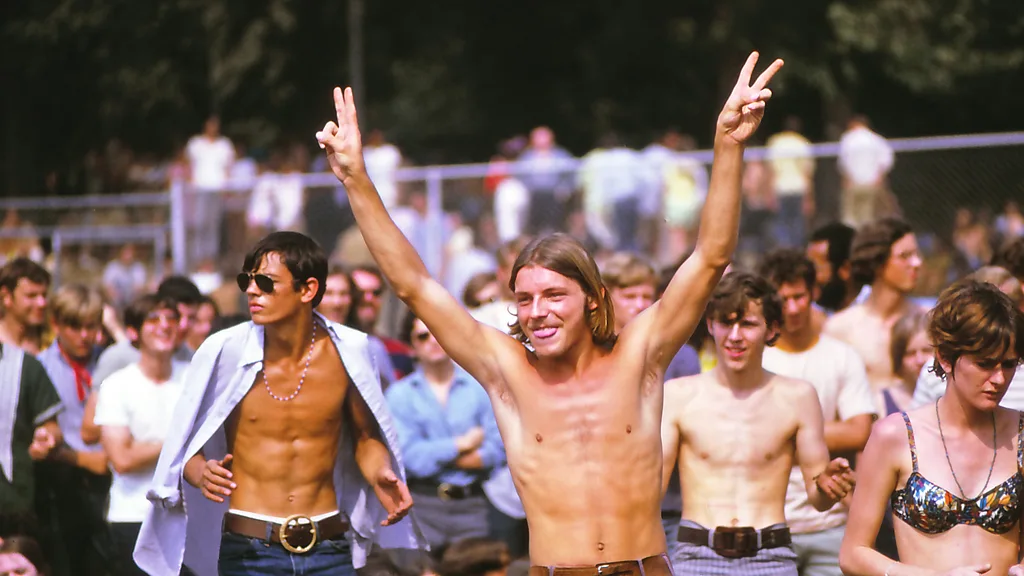
Furthermore, Lang and Scher made a series of decisions that, individually and collectively, created the conditions for disaster. Indeed, these were not accidents or unforeseen circumstances — they were choices with predictable consequences that neither man appeared to have adequately considered.
Critical Organizer Decision Failures Table
| Decision | Consequence | Result |
|---|---|---|
| Venue: Griffiss Air Force Base tarmac | Miles of black asphalt in July heat | 100°F+ temperatures retained in concrete; no natural shade |
| Charging $4 per water bottle | Attendees unable or unwilling to pay | Dehydration, heat stroke, 700+ treated for heat exhaustion by midpoint |
| Cutting costs on infrastructure | Sanitation failure; waste in water supply | Trench mouth (WWI-era gum disease) spread among thousands of attendees |
| Inadequate security staffing | Security overwhelmed by 400,000 people | Unable to control crowd, prevent assaults, or manage riots |
| Insufficient medical resources | Undertrained, undersupplied medical team | Preventable deaths from heat stroke; DeRosia lawsuit |
| Selling $12 pizza slices | Price gouging created rage and resentment | Contributed to atmosphere of hostility and exploitation |
| Booking aggressive artists in peak heat | Crowd volatility at maximum during hottest hours | Fires, riots, and assault peak during Limp Bizkit and Korn sets |
Lang’s Denial
Furthermore, it is important to note that Michael Lang consistently denied these allegations during his lifetime. Woodstock event promoter Michael Lang always refuted negligence claims, saying that organisers had provided plenty of water and Gatorade to medical tents. He also claimed they opened additional cool-down facilities in response to the climbing temperatures. Indeed, Lang died in January 2022 at the age of 77 before Netflix’s Trainwreck documentary fully aired — meaning he never publicly responded to the comprehensive case made against him by that production. Moreover, Michael Lang, the co-creator and organizer of 1969’s Woodstock Music and Art Fair, and its follow-ups Woodstock ’94 and the ill-fated Woodstock ’99, died Saturday at the age of 77 at Sloan Kettering in New York City. The cause of death was a rare form of non-Hodgkin’s lymphoma. Consequently, his death without a full public accounting of his decisions remains one of the unsatisfying loose ends of the Woodstock 99 story.
The Sanitation Disaster: Trench Mouth and Contaminated Water
A WWI-Era Disease at a 1999 Music Festival
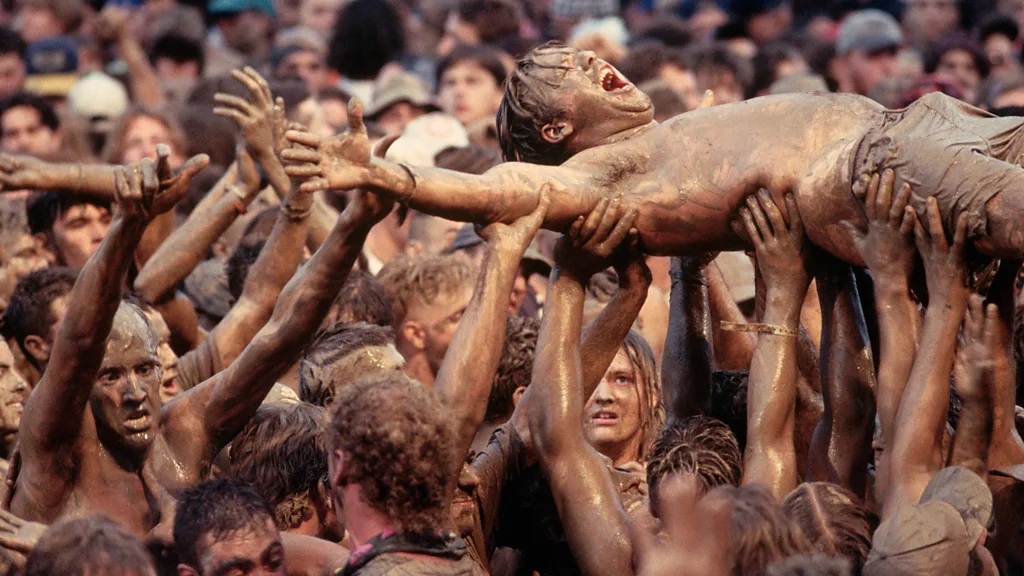
Furthermore, beyond the deaths, one of the most disturbing public health failures of Woodstock 99 was the outbreak of trench mouth — a bacterial gum infection that was common in the trenches of World War I. Indeed, this condition caused gum bleeding, swelling, pain, and ulcers — and it spread at Woodstock 99 because sewage on site leaked into drinking and shower water. Moreover, this is not an edge case or a minor complication — it is a catastrophic sanitation failure that exposed hundreds of thousands of people to contaminated water. Consequently, attendees who came for music left with a disease associated with the most horrific conditions of the First World War.
What Lee Rosenblatt Said
Furthermore, the feelings of exploitation and dehumanization felt by attendees were not just individual grievances — they were institutional observations made by people inside the production itself. Lee Rosenblatt, a member of the festival’s production team who appeared on the documentary, said the attendees were “treated like animals,” and so began to act like animals. Indeed, this observation — from inside the festival’s own production team — is perhaps the most damning assessment of the organizers’ approach. Moreover, it establishes a direct causal chain between the conditions created by the organizers and the behaviour that ultimately spiralled into riots, fires, and assaults. Consequently, the chaos of Woodstock 99 was not a spontaneous eruption — it was a predictable response to a dehumanizing environment.
Limp Bizkit and Fred Durst: Were They to Blame?
The Most Talked-About Performance
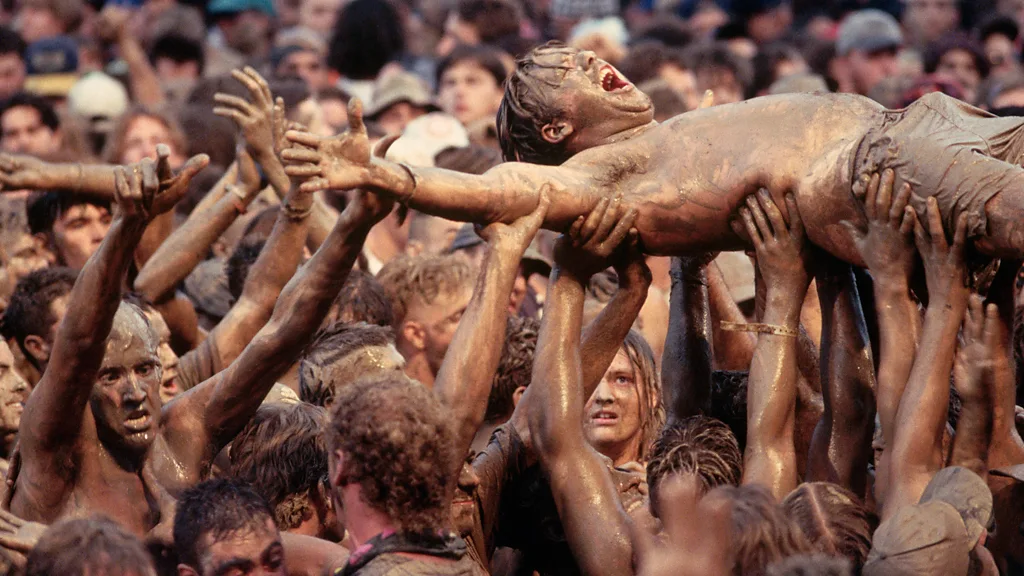
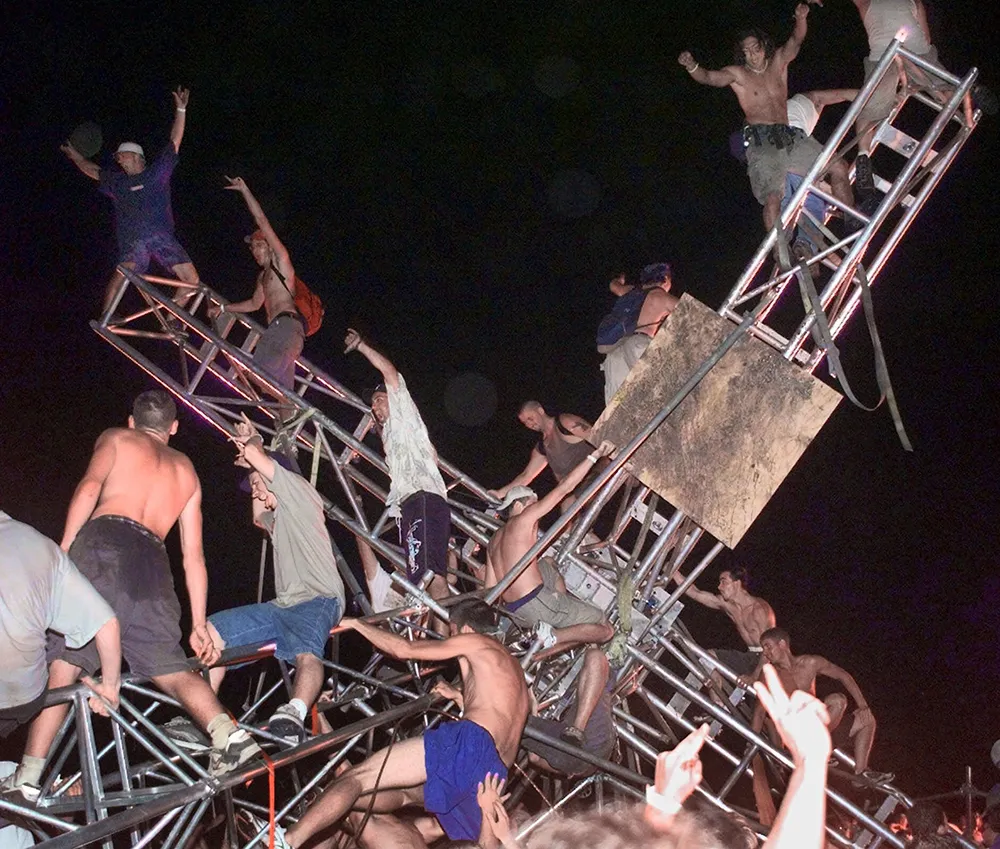
Furthermore, Woodstock ’99 ended in absolute chaos and much of the blame was pointed at the then-ascending nu-metal group Limp Bizkit. The Woodstock 99: Peace, Love, and Rage documentary from 2021 seemed to target Limp Bizkit and frontman Fred Durst, who commanded over a crowd that had begun to scale on-site structures and tear things apart. Indeed, Fred Durst’s performance was the most visible flashpoint of the festival — the moment where the crowd’s simmering tension became overt chaos. Moreover, his repeated encouragements to the crowd to “break stuff” — notably during the song of the same name — are widely cited as fuel on an already burning fire.
The Case Against Limp Bizkit
Furthermore, the case for placing some responsibility on Limp Bizkit and Fred Durst centers on the principle that performers have a duty of care to their audience. Indeed, at a festival where 400,000 overheated, dehydrated, and increasingly agitated people had spent two days in deteriorating conditions, a performer who actively encouraged violence and property destruction was making a dangerous situation worse. Moreover, the timing of their set — during peak afternoon heat — meant their performance coincided with the worst moment of crowd vulnerability. Consequently, even if their music did not cause the chaos, it demonstrably accelerated it.
The Case Against Placing Full Blame on Them
Extreme heat, shortage of supplies, overcrowding and aggressive music doesn’t exactly make for three days of peace and love. Is it possible that absolutely nobody else could, at the least, share some of this blame? Or even own up to it outright? Furthermore, how could it all be pointed at a band? Indeed, the conditions that made Woodstock 99 dangerous were created by the organizers — not Limp Bizkit. Moreover, a crowd that had been dehydrated, price-gouged, exposed to contaminated water, and inadequately protected from the heat for two days was already primed for exactly the kind of explosion that Durst’s set triggered. Consequently, blaming Limp Bizkit for the chaos is like blaming a match for a fire that was already saturated in gasoline.
The Limp Bizkit Debate Summary Table
| Argument | For Limp Bizkit Blame | Against Limp Bizkit as Primary Blame |
|---|---|---|
| Performance content | “Break Stuff” lyrics actively encouraged violence | Song performed under these conditions everywhere without riots |
| Crowd behavior during set | Crowd began dismantling structures during their set | Crowd was already at breaking point before their set |
| Performer responsibility | Artists have duty of care to audience safety | Organizers are primarily responsible for safety — not performers |
| Broader context | Set occurred at peak tension moment | Conditions created by organizers made violence inevitable |
| Fred Durst’s response | Has never fully apologized for the performance | Has pointed to organizers as responsible for conditions |
The Sexual Assaults: A Separate Horror
An Epidemic of Violence Against Women
Furthermore, beyond the deaths and riots, Woodstock 99 was marked by a disturbing epidemic of sexual assault. Indeed, the combination of extreme intoxication, a hyper-masculine crowd atmosphere, woefully inadequate security, and the festival’s general breakdown of norms created conditions in which women were systematically targeted. Moreover, the problem was so widespread that it was visible in documentary footage — women being passed through crowds against their will while those around them either ignored it or participated. Consequently, this dimension of Woodstock 99 remains one of its most painful legacies and one of the most direct indictments of the organizers’ failure to provide adequate safety infrastructure.
The Candle Vigil Turned Riot
Furthermore, one of the most bitterly ironic moments of Woodstock 99 was the way the final evening’s peace candle vigil — intended to honor the shooting victims of Columbine, which had occurred three months earlier — became the spark for the festival’s most destructive riots. Indeed, the candles that were handed out for the vigil were used to set fires across the festival site. Moreover, ATM machines were destroyed, medical tents were set ablaze, and large sections of the festival infrastructure were burned or demolished. Consequently, the final act of a festival that began with aspirations to recreate the peace and love of 1969 was the burning of the very space it occupied.
The Netflix Documentaries: How They Changed the Narrative
Trainwreck: Woodstock ’99 (Netflix, 2022)
Furthermore, Netflix’s three-part documentary Trainwreck: Woodstock ’99 — released in August 2022 — brought the full story of the festival to a new global audience. The documentary casts much of the blame on the organizers’ focus on turning a profit, which resulted in poor management, price gouging for necessities like food and water and unsanitary conditions. Because of the poor living environment, the documentary asserts, many of the festivalgoers resorted to hostility. Indeed, the documentary’s framing — profit over people as the root cause of disaster — has become the dominant narrative for understanding Woodstock 99. Moreover, it draws direct lines between specific commercial decisions and specific human consequences. Consequently, after Trainwreck, the organizers’ accountability became much harder to dismiss or minimize.
Woodstock 99: Peace, Love, and Rage (2021)
Furthermore, the HBO documentary Peace, Love, and Rage — released a year before Trainwreck — focused more specifically on the performers and the cultural context of the festival. Indeed, it placed greater emphasis on Limp Bizkit’s role in the chaos and explored the nu-metal cultural moment that gave the weekend its particularly volatile energy. Moreover, its framing generated more debate about individual performer responsibility than Trainwreck’s organizer-focused analysis. Consequently, the two documentaries together provide a more complete picture than either offers alone.
Key Figures in the Woodstock 99 Story
Michael Lang
Born May 30, 1980 (age 45). Wait — that refers to Gerrard. Let me correct this.
Michael Lang was the co-creator of the original 1969 Woodstock festival. Furthermore, he co-organized Woodstock 99 alongside John Scher. Indeed, he consistently denied negligence claims about the festival’s conditions and died in January 2022 at age 77 of non-Hodgkin’s lymphoma. Moreover, he never fully answered for the organizational failures that contributed to the deaths and chaos at Woodstock 99.
John Scher
Furthermore, John Scher was the co-promoter of Woodstock 99 alongside Michael Lang. Indeed, he was responsible for many of the commercial decisions — including the pricing structures and vendor contracts — that created the atmosphere of exploitation at the festival. Moreover, he has been more visibly defensive in media coverage of Woodstock 99 than Lang was.
Fred Durst and Limp Bizkit
Furthermore, Limp Bizkit’s frontman Fred Durst remains the most publicly discussed individual performer in the context of Woodstock 99’s chaos. Indeed, his “Break Stuff” performance during the festival’s most volatile period is the most cited example of performer irresponsibility. Moreover, he has addressed the controversy multiple times without offering a full apology. Consequently, his role remains debated — a genuine contributing factor to specific moments of chaos, but not the root cause of the systemic failures that killed three people.
Woodstock 99 Casualties: The Full Medical Picture
The Scale of Human Suffering
Furthermore, beyond the three deaths, the human cost of Woodstock 99 extended across thousands of people. Indeed, the full medical picture paints a portrait of catastrophic institutional failure affecting a vast number of attendees.
Medical Statistics Table
| Medical Metric | Figure | Source |
|---|---|---|
| Total medical cases (NY Dept of Health) | 5,162 | New York State Department of Health |
| Hospitalizations | 60 | San Francisco Gate (1999) |
| Treated for heat exhaustion/dehydration (midpoint) | 700+ | Baltimore Sun |
| Total admissions to on-site medical facilities | 1,200 | Pitchfork |
| Deaths | 3 confirmed | MTV, law enforcement reports |
| Trench mouth cases | Widespread | Multiple media sources |
| Sexual assault reports | Multiple; many unreported | Investigative reporting; documentary evidence |
Frequently Asked Questions
Q1: Who is responsible for the Woodstock 99 deaths?
The primary responsibility lies with festival organizers Michael Lang and John Scher, whose cost-cutting decisions created dangerous conditions including inadequate water, extreme heat, contaminated supplies, and insufficient medical and security staff.
Q2: How many people died at Woodstock 99?
Three people died at Woodstock 99 — 24-year-old David G. DeRosia, who died from heat-related illness, 28-year-old Tara K. Weaver, who was hit by a car while walking along the road after having car troubles, and a 44-year-old man with a pre-existing heart condition who died of cardiac arrest.
Q3: Did David DeRosia die from heat at Woodstock 99?
Yes. Furthermore, DeRosia collapsed watching Metallica and died two days later on July 26, 1999, from hyperthermia probably secondary to heat stroke. His mother sued the festival promoters for negligence.
Q4: Is Limp Bizkit responsible for the Woodstock 99 deaths?
No — not for the deaths specifically. Furthermore, their performance accelerated crowd chaos, but the deaths were caused by heat stroke, a car accident, and cardiac arrest — not directly by their set. The primary responsibility lies with the organizers.
Q5: What was the Woodstock 99 water situation?
The organizers charged $4 per water bottle in 100-degree heat. Furthermore, this price gouging — combined with contaminated water from sewage leaking into drinking supplies — led to mass dehydration, heat stroke, and even trench mouth spreading among attendees.
Q6: What is trench mouth and how did it spread at Woodstock 99?
Trench mouth is a bacterial gum infection causing bleeding, swelling, and ulcers. Furthermore, it spread at Woodstock 99 because sewage leaked into the festival’s drinking and shower water supply — a catastrophic sanitation failure caused by inadequate infrastructure.
Q7: Did anyone go to jail for Woodstock 99?
No criminal charges were brought against the organizers or performers for the deaths or riots. Furthermore, several lawsuits were filed — including by DeRosia’s mother — but full legal resolution has not been publicly confirmed for most cases.
Q8: When were the Netflix documentaries about Woodstock 99?
The HBO documentary Peace, Love, and Rage was released in 2021. Furthermore, Netflix’s three-part Trainwreck: Woodstock ’99 was released in August 2022 and reignited global discussion about responsibility for the deaths and chaos.
Q9: What happened to Michael Lang after Woodstock 99?
Michael Lang continued to work in the music industry and attempted to organize Woodstock 50 in 2019 — a festival that collapsed entirely before it happened. Moreover, he died in January 2022 at age 77 of non-Hodgkin’s lymphoma, before the Netflix documentary aired.
Q10: How many people attended Woodstock 99?
Furthermore, over 400,000 people attended Woodstock 99 at the former Griffiss Air Force Base in Rome, New York from July 23 to 25, 1999 — making the scale of the organizational failures and human casualties all the more extraordinary.
The Bottom Line
Who is responsible for the Woodstock 99 deaths? The most honest and comprehensive answer is: primarily the organizers — Michael Lang and John Scher — whose profit-driven decisions created the conditions that killed three people and injured thousands more. Furthermore, their choice of a concrete tarmac venue in July heat, their decision to charge $4 for water in 100-degree temperatures, their failure to provide adequate medical staff, their sanitation failures that led to a WWI-era disease spreading among attendees, and their deployment of completely insufficient security — these were not accidents. Indeed, they were choices, made by people who prioritized revenue over human safety.
Moreover, Limp Bizkit played a real role in accelerating the most violent moments of the festival — and that role deserves honest acknowledgment rather than dismissal. Furthermore, Fred Durst’s conduct during the most volatile period of the event added fuel to a fire that should have been controlled by the people in charge of the event’s safety. However, performers do not bear primary responsibility for the systemic failures that killed people. Consequently, the Woodstock 99 story is ultimately a story about institutional negligence — about what happens when the people entrusted with the safety of 400,000 human beings treat them, in the words of the festival’s own production team member, “like animals.”
Last Updated: April 2026 · All information based on publicly available media reports, court records, documentary evidence, and verified historical accounts.
