

As individuals learn about the behavior frameworks, the director personality type always raises a question. This is a term used to describe a person who is confident and quick at making decisions and strives for results without second thoughts. Meanwhile, many workplaces appreciate this style as it enables projects to proceed swiftly. It is thus important to consider the director personality type because as an understanding of this type deepens, cooperation, relationships, and personal development will enhance. This article looks at what this style is, its importance and its relevance to everyday life.
How would you describe the personality of a director?
The personality type of the director is the one who is decisive, goal-oriented and works well in a crisis situation. This type is much more structured, wants clear results and quick action. As a result, individuals with this style tend to get into positions of leadership at an early stage of their careers.
There are a few variations on the same concept, both in the psychology and behavioral coaching world. The profile indicates someone who prefers to focus on getting things done rather than engaging in conversation, and who prefers to focus on outcomes over extended conversations. Plus, this person is sometimes forthright and values honesty and hates squandered time at meetings and projects.
Origins of the Term
The director personality type is mentioned in a few personality models such as DISC and in various leadership models when referring to a dominant action style. In the meantime, business coaches took this term up, as it reflects the natural way in which some leaders function in organizations. So the word quickly spread through corporate training programs and self-help books.
In the past, these characteristics were described differently, even though they did not have any specific frameworks. In ancient documents leadership that focused on results was frequently likened to that of a military leader or a politician. Psychologists further developed these observations into structured models, usable in business practice, over the years. With today’s training, assessments and workshops, trainers help employees identify this pattern in themselves and others.
They are a group of characteristics that define this style
Those with this profile typically exhibit common characteristics. They like to control what happens, make decisions quickly, and do not like being unsure for long periods of time. In addition, they tend to have high expectations of their own and of their team members.
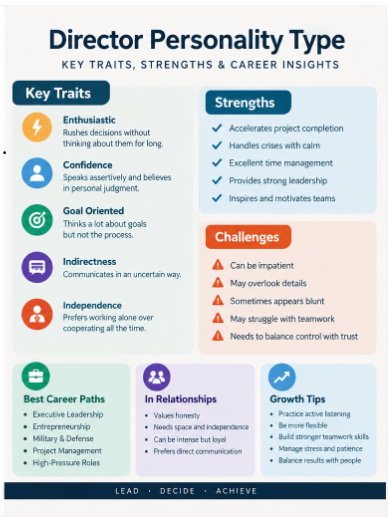
The Director personality type has the following characteristics:
Knowing certain characteristics can provide a better insight into the director personality type in real life. A table is provided to summarize the common features in most descriptions of the style.
| Trait | Description |
|---|---|
| Enthusiastic | Makes quick decisions without thinking about them for long |
| Confidence | Speaks assertively and trusts personal judgment |
| Goal-Oriented | Focuses heavily on goals rather than the process |
| Indirectness | Communicates in an uncertain or unclear way |
| Independence | Prefers working independently rather than always cooperating with others |
| Effective Under Pressure | Works well when situations are critical or urgent |
| Leadership | Commonly used by entrepreneurs, executives, and military leaders |
| Decisiveness | Does not avoid difficult discussions or tough decisions |
This style may also be shown through body language as these people tend to stand up tall, eye to eye and speak with a firm tone. Co-workers often say they are intense and inspiring – the energy they give gets a whole team going. Moreover, this presence usually provides respect to them easily, even if they are not personally acquainted with them.
The Director personality type has several strengths
Each personality type has their own set of strengths, and the director personality type has some great attributes to contribute to any team. Firstly, this style is good at accelerating the completion of projects on time. Secondly, individuals with this type of personality react to crises calmly because they have confidence in their own judgment.
Leadership Under Pressure
The director personality type is at its best in times of crisis or when things are at stake. Others hesitate, this one takes up the ball, gives instructions and leads the group to the solution soon. For this reason, these people are frequently assigned to run things in a crisis situation or when there’s a tight deadline.
The key to efficiency is time management
One of the other things of note is that this is a very strong time management attribute that not many styles can easily copy. This personality doesn’t like wasted effort and therefore streamlines processes and avoids unnecessary steps if at all possible. This personality’s teams are, therefore, more likely to complete projects on time than average.
Agendas are kept focused and off-topic conversations are re-directed in a timely manner under this leadership style. This person typically doesn’t have to worry about deadlines being missed, as they’re constantly monitoring progress and working out problems before they get too big. This leadership style can therefore prove to be helpful for colleagues in times when projects are chaotic.
The personality type of Director will encounter the following challenges
While the director personality type has a lot going for it, there are also some problems to address openly. Impatience can sometimes lead to arguments, particularly if they need to reflect on the information or ask questions. Also, the style of communication may not be delicate enough and may hurt the feelings in sensitive exchanges.
Struggles With Delegation
There are many people in this personality type who find it difficult to let go. They have too strong a sense of self-confidence to delegate, even when it is very practical. Therefore, when this person declines to share responsibilities with other competent co-workers, they are very likely to experience burnout.
Often this reluctance is based on a lack of trust, as it was reinforced by previous experiences with untrustworthy team members, where they had to do everything themselves. This cycle can typically be broken with small steps over time – e.g. start with low risk tasks and build trust over time. Delegation can become a real lever of influence, not a loss of control, with practice.
Difficulty Accepting Feedback
Another frequent difficulty is taking criticism well. This is a person who may see criticism as a challenge, not as valuable advice. Thus, it is crucial to distinguish between the self and development in the process of learning, which is a skill for growth that must be learned.
At times, colleagues may be surprised by how sensitive he is to correction, as he looks and feels confident and secure in his personality. But, behind all this confidence, there is always this sense of fear that one might look incompetent when evaluated.But, there is always this fear lurking in someone’s mind, of appearing incompetent when they are being evaluated. To acknowledge this pattern for what it is is the first significant step in healthier reactions to constructive criticism.
The Relationships section of the Director Personality Type
In personal relationships, the director personality type plays a major role as well. When that trust is established this person is often described as being protective, loyal and extremely committed to their partners. But the same intensity can sometimes lead to tension in the event that compromise is needed.
Individuals with this profile place a high priority on honesty in relationships, above all else. As a result, they value honest partner communication, and will not feel comfortable having a partner resolve issues indirectly. In the meantime, learning patience with partners that have more expressive emotions can be a lifelong learning area.
Friends and Friend Groups.
Typically, the director personality type finds group friendships more appealing than large social networks. Quality is more important than quantity, hence these people invest heavily in relationships they think are valuable. Additionally, this personality type is a good source of trustworthy guidance when making tough choices.
They are close friends because of loyalty; this person is always present when someone is in need of help. They are usually not very interested in small talk and conversations quickly move to larger matters or topics that they might want to accomplish together. As a result, friendships with this personality type tend to last for a long time, and are not based on superficial relationships.
These are the careers that are suitable for the Director personality type
Some professions complement the personality of a director very well and enjoy the ability to make decisions and to be confident. People with this style are always drawn to executive leadership, entrepreneurship, law, and military service. Moreover, this personality is suited to project management as it does not find deadlines and structure stressful.
It also works well for sales and business development, as this personality isn’t easily deterred from rejection. For this type, however, working in a role that demands long patience or slow working can be frustrating. This means that you are more likely to be satisfied with your overall job satisfaction if you opt for a high speed, action oriented business.
This profile would also be suited to the careers of consulting and crisis management, as clients may require quick, authoritative responses during times of stress. The personalities that gravitate toward real estate, competitive sports coaching and finance are similar because, essentially, they are all drawn to the same thing: making money. In almost every industry, the denominator is a desire for short-term gains over long-term improvements.
Ideal Work Environments
The director personality type is best suited to workplaces that allow for creativity and self-reliance. This individual can prove his or her ability with autonomy, and he or she feels stifled by micromanagement. The result is that firms that give real responsibility to employees have a longer tenure for this personality type.
Structures with clear goals that are flexible work well with this person, as this person is more likely to succeed when given ownership than strict instructions. This type is commonly found in start-ups and fast-growing businesses, as they are comfortable with uncertainty and are used to changes. Conversely, extremely bureaucratic firms may annoy this personality, which can result in early resignation unless management adjusts.
How the Director Personality Type handles Stress Situations
Stress management is unique for each personality style and for the director personality type it is about taking action in the face of stress. This person would not freeze but rather would develop plans and assign tasks and get on with the day’s work. But sometimes, emotional exhaustion can result in an unexpected burnout without any warning signs.
For long-term wellbeing, it’s important to teach children healthy coping. As a result, the director personality type should plan for regular rest breaks, even when they think they are more productive than resting. Furthermore, if you can be patient in an uncertain time, stress levels will significantly decrease with time.
For many people, physical activity is a great way to relieve tension that can build up from being constantly making decisions during a hectic day. Journaling as well offers an individual way of working through the frustration that doesn’t unnecessarily burden teammates. With time, a blend of routine and sometimes spontaneity brings a healthy balance of drive and authentic rest.
Growth Strategies for the Director Personality Type
The personal development of each style is slightly different, but there are some strategies that can enhance development specifically for the director personality type. Active listening, for instance, is a way of balancing natural directness and empathy towards others. Gradually learning to delegate on the other hand, helps to dramatically decrease the risk of burnout.
This personality type needs to slow down from time to time, and mindfulness exercises can help him achieve that. Therefore, if you make time to be quiet regularly, you will be better equipped for long term decision-making. Also, actively asking for input, not avoiding it, helps personal development significantly down the road.
Building Emotional Intelligence
The director personality type has a potential growth focus on emotional intelligence. It’s more beneficial for relationships to recognise others’ emotions, not just the product. So when purposeful development in this area occurs, it can develop good leaders into great ones.
This skill can be practiced gradually over time, including taking a step back before reacting in a stressful conversation. It also helps to establish trust gradually by asking sincere questions about how teammates feel, rather than making assumptions about their view. These small changes add up over the course of months and years to significantly improved, more well-rounded leadership.
The Director Personality Type When compared with other Personality Types
Learning about the differences between the director personality and other common personality types will make it easier to understand director’s role in any system. This style is more task oriented than the other types, so it focuses on tasks rather than feelings in most circumstances. This personality, contrary to analytical types, acts quickly, without much previous study.
This juxtaposition is what makes this personality type less likely to mix well with slower more methodical team members when working on joint projects. But, these differences also lead to balance, as teams usually are more successful when they are diverse. Thus, understanding these differences can enable teams to value each individual’s contribution.
For example, a combination of this decisive leader and a detailed planner can yield better results than either can do on their own. The planner is able to identify risks that may be missed by a quick decision and the leader does not let momentum stall. Smart managers understand this complementary nature and create teams intentionally comprised of these opposite strengths.
Reflections on the Director personality type
Knowing the personality of the director can be helpful to understand why some people are natural leaders in this pressure. They are confident, decisive and have a goal oriented mindset which makes them a valuable addition to teams, relationships and organisations. But growth is an act that must be done with patience, empathy and openness to feedback. In essence, the director personality type is driven by ambition and action, and when combined with self-awareness, can produce amazing results.
The difficulties above should not make anyone afraid. Instead, they should encourage self-awareness. Every strength has a shadow side. If ignored, it can cause harm. Strong leadership can become balanced and lasting with effort and patience. Honest self-reflection also helps develop better leadership.
Frequently Asked Questions FAQs
Q1: What defines the director personality type?
The director personality type describes someone decisive, confident, and goal-driven, who prefers fast action over lengthy deliberation during most situations.
Q2: Are people with the director personality type good leaders?
Yes, the director personality type often excels in leadership roles because they handle pressure calmly and make quick, confident decisions.
Q3: What careers suit the director personality type best?
Executive leadership, entrepreneurship, law, and project management typically suit the director personality type due to their fast-paced, results-driven nature.
Q4: Does the director personality type struggle with relationships?
Sometimes, since directness and impatience can create friction, though loyalty and honesty make this personality type a committed, dependable partner.
Q5: Can the director personality type change over time?
Yes, with intentional effort, the director personality type can develop patience, empathy, and better listening skills through consistent practice.
