
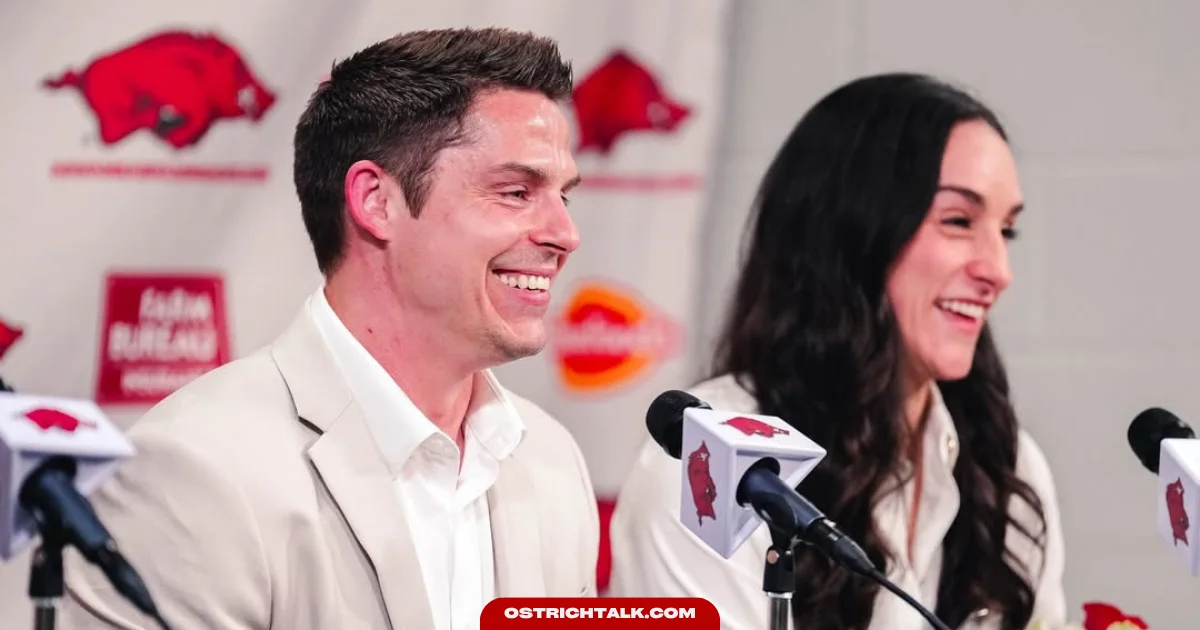
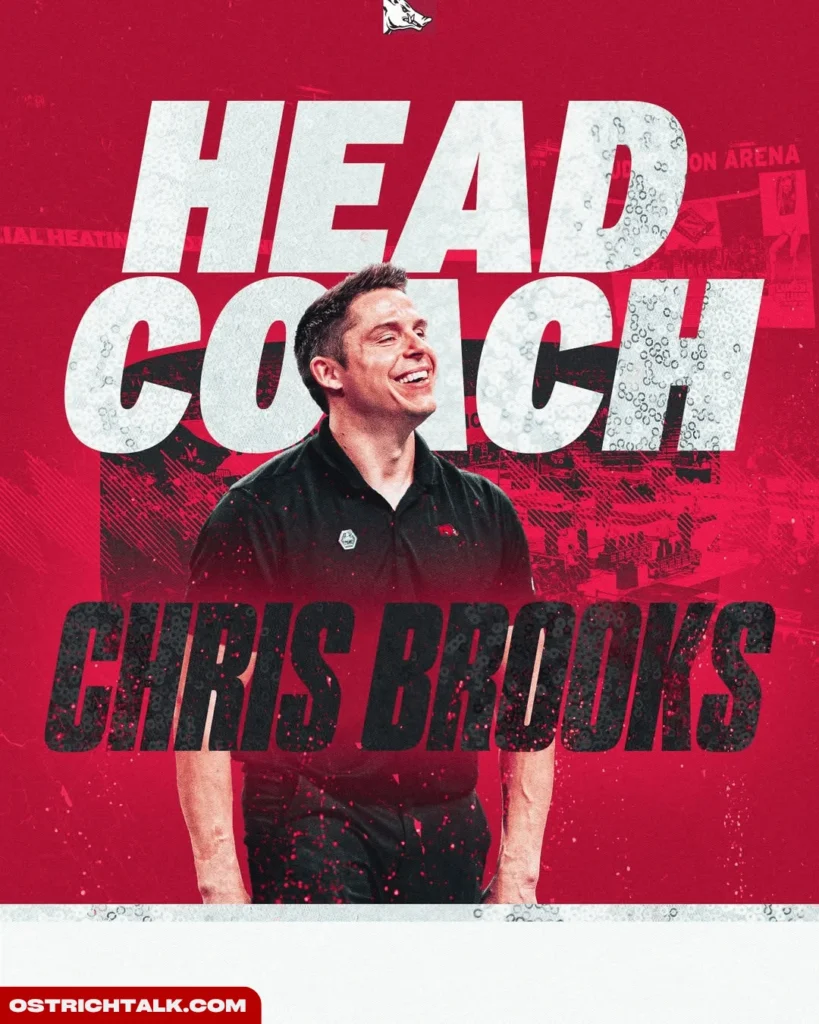
When Arkansas athletics director Hunter Yurachek approached Chris Brooks in April 2026 about taking over the gymnastics program, Brooks had one immediate reaction. He was not sure where the conversation would leave him. His wife, Jordyn Wieber, had just told Yurachek she was stepping down after seven seasons. Brooks had spent those same seven years beside her as the program’s primary uneven bars coach. He had watched Arkansas grow from a solid regional competitor into a program that set SEC gymnastics attendance records. He had helped build it. Now the question was whether he would lead it. According to Whole Hog Sports, he told reporters at his introductory press conference: “I wasn’t sure where that was going to put me. Honored that he would be that confident and ready to have me step up.” That moment of honest uncertainty, from a man who spent nearly two decades pushing through injuries, setbacks, and near-misses to reach the Olympics, says a great deal about who Chris Brooks is.
A Houston Family Built Around Gymnastics
Christopher Dean Brooks was born on December 19, 1986, in Houston, Texas. Gymnastics ran through his family before he ever touched a bar. His father, Larry Brooks, was a gymnast and the person most responsible for putting Chris on the path that defined his life. According to USA Gymnastics records, Brooks began competing in 1991, at just four years old. His brother Nick and sister Erica both had involvement in the sport as well, with Nick later competing in gymnastics and Erica adding cheerleading to her gymnastics background.
Brooks trained as a junior at Houston North Gymnastics Club under coach Bill Foster. He was a member of the U.S. junior national team from 1999 to 2001 and again from 2002 to 2005. In 2003, he won gold at the USA national championships as a junior competitor. He was a highly ranked young gymnast heading toward what looked like a straightforward path to senior elite competition and, eventually, an Olympic team.
Then 2004 happened.
The Injury That Should Have Ended Everything
In 2004, while training on the horizontal bar, Brooks suffered a grip lock. His grips caught the bar during a Kovacs element, a release move requiring the gymnast to let go of the bar, complete a flip, and regrasp. When the grip locked, his arm did not release cleanly. The result was catastrophic. According to Alchetron and Wikipedia, the grip lock shattered and splintered both the ulna and radius of his right arm.
That injury ends careers. Many gymnasts at that level, facing the destruction of both forearm bones during a bar element, do not return to elite competition. Brooks returned. The recovery was long. The mental block that followed, particularly around the horizontal bar, stayed with him for years. He told GymCastic in a podcast interview that the high bar created a mental hurdle that he actively worked to overcome throughout his senior career. The injury formed one of the defining challenges of his athletic life, not just physically but psychologically.
He also lost his father during his college years. According to Alchetron, Larry Brooks died in a car accident in 2008, while Chris was competing for the University of Oklahoma. His father had been the reason he started gymnastics in the first place. Losing him mid-career, at a point when elite competition was already demanding everything Brooks had, placed an additional weight on an already complicated athletic journey.
The way Brooks navigated both of those losses, the physical devastation of the grip lock and the personal grief of losing his father, became central to the narrative others later attached to his Olympic story. Brook did not talk about overcoming these things in dramatic terms. He trained. He competed. Brook kept showing up.
College Career and the NCAA Championships at Oklahoma
Brooks enrolled at the University of Oklahoma, where he competed for the Sooners from 2006 to 2009. He earned a degree in Business Management. According to Team USA’s official athlete profile, he helped lead Oklahoma to the 2008 NCAA national championship. He earned seven All-American honors during his collegiate career, according to Grokipedia, and won the 2006 Mountain Pacific Sports Federation high bar title.
Oklahoma was, and remains, one of the premier men’s gymnastics programs in the country. Competing there gave Brooks experience at the highest level of collegiate competition and access to coaching and training resources that matched his talent. His performance as a Sooner translated directly into national team consideration at the senior elite level.
After graduating, he returned to Houston to train at Cypress Academy of Gymnastics under coach Tom Meadows, alongside fellow national team member Jonathan Horton. That training environment kept him connected to elite competition after his collegiate career ended. The work he put in at Cypress shaped what followed at the senior international level.
Senior Elite Career: A Decade of Near-Misses and Breakthroughs
The senior phase of Brooks’ career stretched from 2009 to 2017 and contained more plot turns than most athletes accumulate in a lifetime. Brook high bar and parallel bars skills made him a consistent contender. His resilience through injury made him a recurring story. Brook repeated near-misses with Olympic selection made him a figure that gymnastics followers invested in across multiple Olympic cycles.
In 2010
Brooks won the Winter Cup all-around and horizontal bar titles with a bronze on vault, according to USA Gymnastics records. Brook went on to the American Cup that year, where he won bronze in the all-around. He competed at the Japan Cup and helped the USA men’s team to a bronze medal finish. Brook also qualified for the 2010 World Championships team, advancing to the horizontal bar final and finishing sixth.
The 2012 Olympic cycle brought him to the edge of what he had been working toward for years. At the 2012 Pacific Rim Championships, Brooks was dominant, winning four individual gold medals and leading the team to the top of the podium, according to Alchetron. He entered the Olympic Trials with genuine momentum. His combined scores at the Trials placed him joint fourth alongside Jake Dalton. When the selection committee announced the team on July 1, 2012, Brooks was named as an alternate. He would not compete in London.
That alternate designation at 25, after years of work, after the grip lock, after losing his father, after the long rebuilding process, was the kind of moment that ends careers without a single formal announcement. Brooks did not allow it to end his.
| Competition | Year | Achievement |
|---|---|---|
| USA Junior National Championships | 2003 | Gold medal |
| NCAA Championships (Oklahoma Sooners) | 2008 | Team national champion |
| Winter Cup | 2010 | All-around champion, horizontal bar champion |
| 2010 World Championships | 2010 | Team member; horizontal bar finalist (6th) |
| 2012 Pacific Rim Championships | 2012 | Four individual gold medals; team gold |
| 2012 Olympics | 2012 | Named alternate; did not compete |
| Winter Cup | 2014 | All-around champion |
| 2015 World Championships | 2015 | Team member; sixth on horizontal bar |
| 2016 U.S. Olympic Trials | 2016 | First on parallel bars and high bar; second all-around |
| 2016 Rio Olympics | 2016 | Olympic team captain; 14th all-around; team fifth |
| Retirement | August 2017 | Announced retirement from competitive gymnastics |
The Road to Rio: Elimination of Everything That Did Not Help
The four-year stretch between the 2012 alternate announcement and the 2016 Olympic Games shaped Brooks as an athlete and, eventually, as a coach. He approached that period with a deliberateness he later described to Team USA. According to Team USA’s official content, he said: “I basically looked at my life and took everything that wasn’t helping me and I just removed it from my life. If it was distracting or if it wasn’t helping me somehow, mentally, physically, emotionally, I just removed it.”
That level of self-assessment at 26, following a major disappointment, is not common. Most athletes at that stage either double down on what they have always done or quietly walk away. Brooks did something more methodical. He audited his own life, identified what served his goals, and cut the rest. That approach eventually produced the result he had spent years pursuing.
In 2015
Brooks competed at the World Championships, finishing sixth on horizontal bar and earning a team fifth-place result. He entered 2016 as one of the more seasoned and technically reliable members of the national team. At the U.S. Olympic Trials in St. Louis, he finished first on parallel bars and high bar and second in the all-around, according to USA Gymnastics records. On June 25, 2016, he received the call confirming his spot on the five-man Olympic team. He was 29 years old.
According to Fox News, at the Olympic qualifying round in Rio, Brooks drilled his high bar set and let out a scream when he landed it. He reportedly said it was the best routine of his life. His parallel bars total across four qualifying rounds led the entire field. The U.S. team finished fifth overall. Brooks placed 14th in the individual all-around final. His teammates selected him as team captain, a recognition from the people who had watched him compete and train across the entire Olympic cycle.
He retired from competitive gymnastics on August 17, 2017, according to Wikipedia.
The Transition Into Coaching
Brooks moved directly from competition into coaching. He spent the 2017-18 season as an assistant coach for the University of Nebraska women’s gymnastics team, focusing on vault and floor exercise. He drew on his experience as an Olympic team captain to work with collegiate athletes in a women’s program, a transition that required him to apply his technical knowledge to a different discipline.
In 2018, he moved to the University of Oklahoma as an assistant coach for the men’s program. Oklahoma had been his collegiate home as an athlete. Returning there in a coaching capacity connected his competitive past to his professional present. According to Team USA’s 2019 feature on him, Brooks briefly considered a comeback during his time at Oklahoma, even getting up on the high bar to test himself. He described how everything hurt the next day and concluded that his contribution to the sport would come through coaching rather than competing.
That period of honest self-assessment, matching the same quality he showed after 2012, was what led him to accept when Jordyn Wieber offered him the assistant coaching position at Arkansas in May 2019.
Seven Seasons at Arkansas: Building the Bars Program
Brooks joined Arkansas as the primary uneven bars coach in May 2019. His arrival coincided with the beginning of what became a sustained rise for the program. He brought technical depth on a single apparatus and applied it consistently across seven seasons.
According to the Arkansas Razorbacks official athletics page, eight of Arkansas’ thirteen best bars scores in program history came during his tenure. He developed gymnast after gymnast on the event, building a coherent technical system on the bars rather than relying on individual talent to produce isolated high scores.
In 2025, the Gymbacks scored a season high of 49.525 on bars, the third-highest total in program history at the time, according to the Arkansas Razorbacks official site. That mark came at the University Park regional semifinal. Senior Maddie Jones earned a 9.950 score at that meet, sharing the program’s first-ever regional bars title.
By 2026, the vault squad under Kyla Ross had set a program record of 49.675. Morgan Price, a senior transfer, landed the first perfect 10 in program history on the vault in February of that year. The overall program had reached a level, in terms of event scores and attendance, that would have seemed unlikely when Wieber and Brooks arrived in Fayetteville seven years earlier.
Brooks also developed a reputation on the arena floor. Anyone watching Arkansas gymnastics during those years noticed his sideline presence. He coached with visible enthusiasm, reacting physically to routines and communicating encouragement to athletes in real time. That style, noted by multiple reporters covering the program, became part of the identity of the Arkansas gymnastics experience.
Head Coach: Taking Over and Setting the Tone
Wieber stepped down on April 28, 2026. Brooks stepped into the head coaching role that same day, effective immediately. According to Yahoo Sports, Yurachek approached him after Wieber informed him of her resignation. The transition involved no outside search, no interim appointment, and no disruption to the program’s daily operations. Brooks already knew the staff, the athletes, the facilities, and the program’s values.
His first major decision as head coach came in early June 2026. According to the Northwest Arkansas Democrat-Gazette, he completed his first staff by hiring Zan Jones and promoting both Kyla Ross and Catelyn Branson to associate head coach. Jones arrived from Texas Woman’s University, where he had served as vault and bars coach during back-to-back WCGNIC national title seasons in 2025 and 2026. Jones earned WCGA Division II Assistant Coach of the Year recognition three times, including in the spring of 2026.
Ross, a former UCLA gymnast and 2012 Olympic gold medalist, had started at Arkansas as a volunteer assistant in 2022. She had helped produce program records on the balance beam across two consecutive seasons before taking over the vault squad, which reached as high as second in the country in 2026. Branson had returned to the staff ahead of the 2025 season and led the floor squad to two of the program’s five best floor scores in history. In 2026, more than 60 percent of the team’s floor scores reached 9.85 or better.
Brooks also inherited a program with record-setting momentum in the stands. The Gymbacks drew 15,512 fans to a single meet against Oklahoma in March 2026, a new program and SEC gymnastics attendance record, according to the Arkansas Razorbacks athletics department.
Personal Life: A Family Rooted in Gymnastics
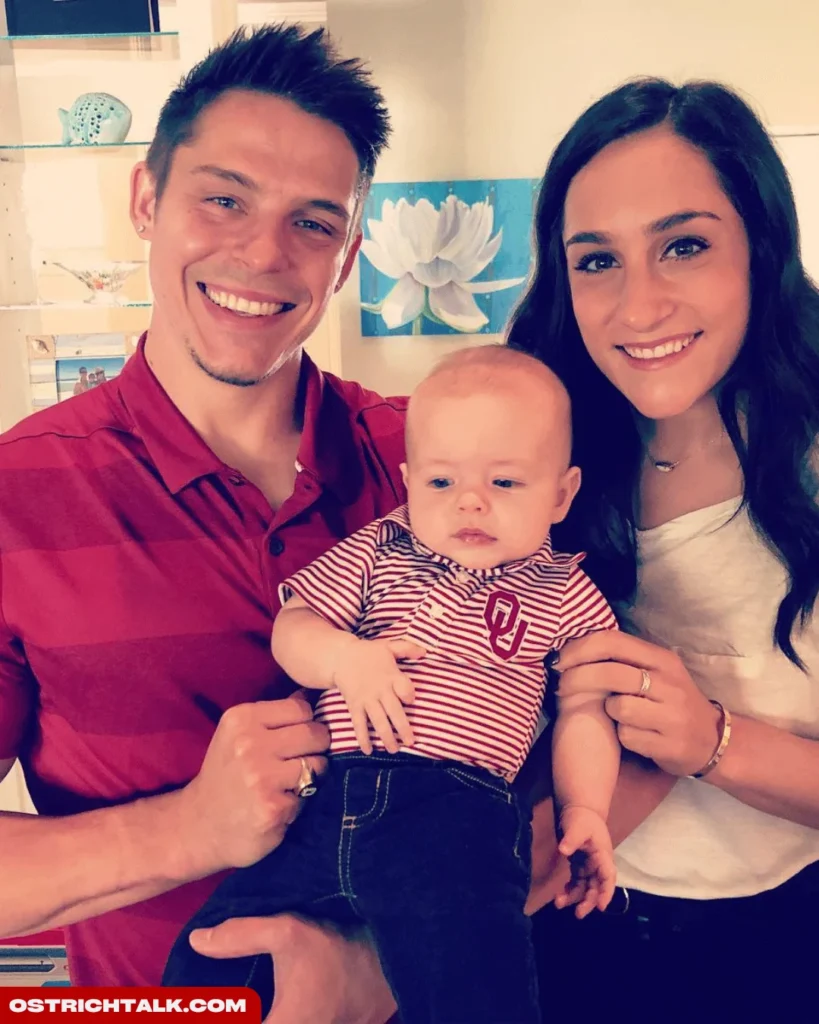
Brooks and Wieber began dating in 2016, the same year he made the Olympic team and the same year she was working as an assistant coach at UCLA. According to olympics.com, the two married in May 2023. Their first child, a daughter named Gigi, was born in June 2025.
The family structure at Arkansas gymnastics is genuinely unusual by any standard. Both parents arrived as Olympic-level gymnasts. Both contributed to the program’s rise over seven years. One stepped aside to focus on family and personal pursuits. The other moved into the program’s top job. Brooks carries the history of both journeys, his own and Wieber’s, into the head coaching role. That shared context gives him a foundation that no external hire could replicate.
His brother Nick coached him for two years following graduation, according to Alchetron, which speaks to the family-centered nature of how gymnastics has always operated in his life. Coaching is not an abstract professional pivot for Brooks. It connects directly to where the sport has always lived for him, in family relationships and the passing of knowledge between people who trust each other.
What the Arkansas Program Inherits Going Forward
Taking over a successful program from a respected predecessor always carries a specific challenge. The standard has already been set. The culture already exists. The question is whether the new leader maintains it, evolves it, or inadvertently dismantles it by trying too hard to make it their own.
Brooks spent seven years inside the culture before stepping in front of it. He did not inherit a stranger’s program. He helped build it. The values Wieber established around athlete welfare, academic performance, and technical development are values Brooks observed and contributed to from day one. The program’s record GPA of 3.72, set in 2025, came from a culture he participated in creating.
Furthermore, his background as an athlete who reached the Olympic stage through sheer persistence rather than a straight path gives him a specific type of credibility with gymnasts navigating their own setbacks. Brook knows what grip lock feels like. He knows what it means to be named an alternate instead of a team member after years of preparation. Brook knows how to remove what is not helping and stay focused on what is. Those are not abstractions from a coaching manual. They are lived experiences that he can draw on directly.
The 2026-27 season will be his first full year as head coach. Whatever it produces, it begins from a foundation that attendance records, program-best academic performances, and seven years of consistent improvement have made unusually strong.
Frequently Asked Questions
Who is Chris Brooks?
Chris Brooks is a retired American gymnast who served as captain of the U.S. men’s gymnastics team at the 2016 Rio Olympics. He is currently the head coach of the Arkansas Razorbacks women’s gymnastics team, a position he assumed in April 2026 after his wife, Jordyn Wieber, stepped down from the role she held for seven seasons.
Did Chris Brooks win an Olympic medal?
No. According to Team USA’s official records, Brooks placed 14th in the individual all-around final and the U.S. men’s team finished fifth overall at the 2016 Rio Olympics. His teammates selected him as team captain for the Games, recognizing his leadership and competitive consistency across the Olympic cycle.
Is Chris Brooks married to Jordyn Wieber?
Yes. Brooks and Wieber began dating in 2016 and married in May 2023, according to olympics.com. The couple welcomed their first child, daughter Gigi, in June 2025. Wieber stepped down as Arkansas head coach in April 2026, and Brooks took over the program immediately.
What coaching positions did Chris Brooks hold before becoming Arkansas head coach?
According to Wikipedia and USA Gymnastics records, Brooks served as an assistant coach at the University of Nebraska women’s gymnastics program in 2017-18, then as an assistant at the University of Oklahoma men’s program in 2018-19, before joining the Arkansas staff as the primary uneven bars coach in May 2019. He held that role for seven seasons before being appointed head coach in April 2026.
Read more about Who Is Jaxson Dart Mom?
