
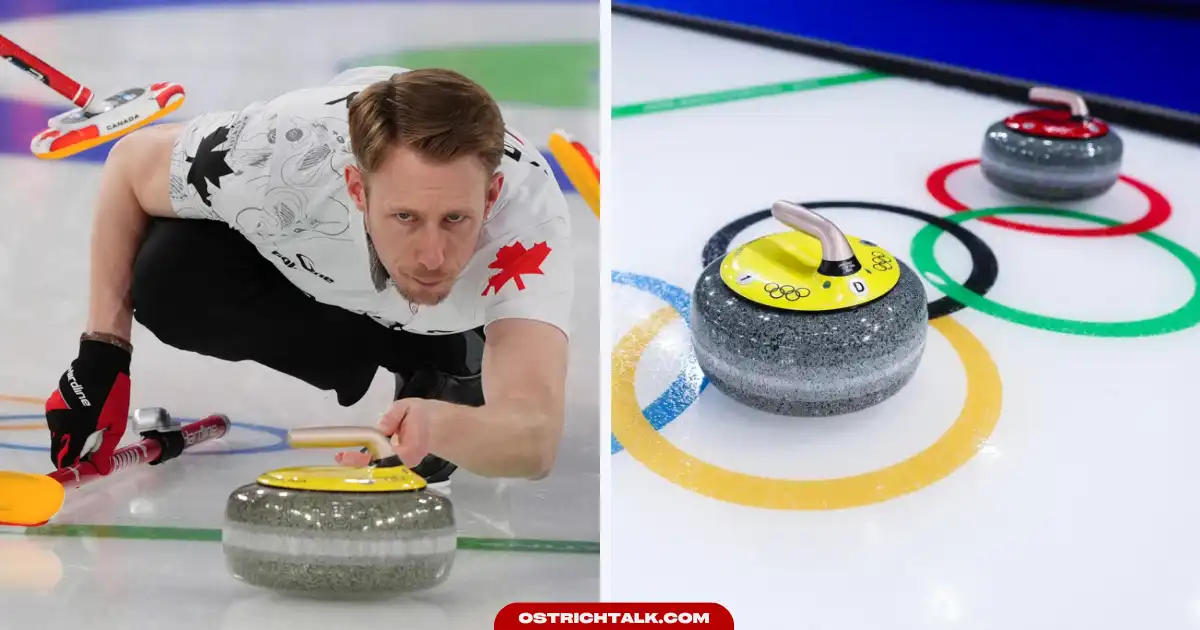
At the 2026 Milano-Cortina Winter Olympics, a single stone settled two millimeters from the button to clinch gold. Two sweepers made that happen. Brushes in Olympic curling are not ceremonial props. They are precision instruments capable of redirecting a 44-pound granite stone by several feet. Yet most viewers still wonder: how do brushes affect the stone’s path in Olympic curling, and why does the sport’s governing body keep banning them? The answer involves physics, friction, and one of sport’s most heated equipment controversies.
What Happens to the Stone When No One Sweeps?
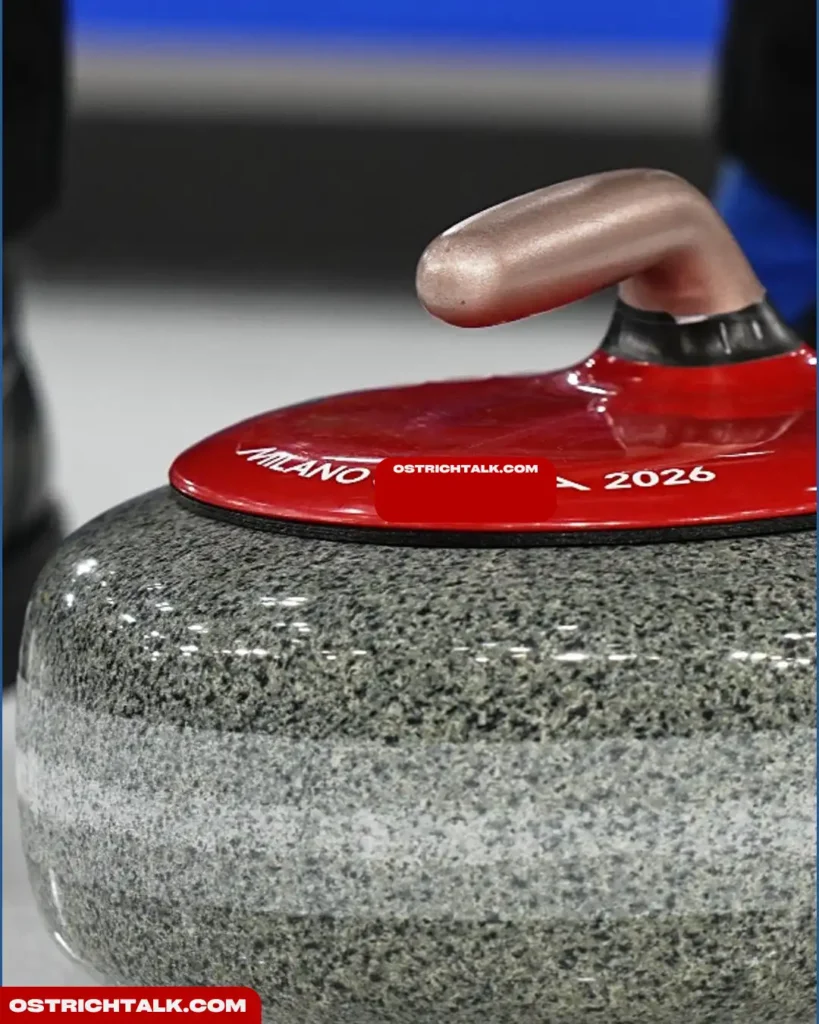
Understanding brushes begins with understanding the ice. Olympic curling is played on pebbled ice, created by spraying tiny water droplets that freeze into small bumps across the sheet’s surface. Those bumps create friction. As the stone slides forward, its running band — a narrow ring on the bottom — makes contact only with the pebble tops. Friction gradually slows the stone. It also causes the stone to curl.
Why Does a Curling Stone Curl at All?
The curl happens because of rotation. When a player releases the stone, they give it a slight clockwise or counterclockwise turn. As the stone decelerates, the leading edge of its running band grips the ice differently than the trailing edge. This asymmetric friction pulls the stone sideways. Consequently, it curves left on a counterclockwise release and right on a clockwise one. Without any sweeping, the stone follows that natural arc entirely uninterrupted.
How Does Sweeping Physically Change the Stone’s Path?
Sweeping generates heat through friction between the brush pad and the ice surface. That heat partially melts the pebble tops. The result is a thin liquid film. This film reduces friction between the stone’s running band and the ice. Less friction produces two measurable effects.
Does Sweeping Make the Stone Go Farther?
Yes, significantly. According to USA TODAY, once sweepers begin brushing, the distance a stone travels increases noticeably. The World Curling Federation has confirmed through research that vigorous sweeping can extend a stone’s distance by several feet. Furthermore, reduced friction also delays the onset of curl. The stone travels straighter for longer before its rotation pulls it off-line. Therefore, sweepers who brush aggressively in the early phase of a shot can straighten its trajectory before releasing pressure and allowing curl to develop closer to the house.
Can Sweeping Actually Steer the Stone?
This is where the science becomes most important for Olympic strategy. Sweepers do not brush the entire path evenly. Elite teams apply more pressure to one side of the stone’s trajectory. Brushing the outside edge of the path reduces friction on that side. The stone naturally drifts toward the lower-friction zone. According to research cited by Circle City Curling, brush head placement relative to the running surface is critical. Brushing the high side of the path causes the stone to curl less. Brushing the low side lets it curl more. In practice, skilled sweepers use this technique to fine-tune a stone’s final position by several feet, even after a flawed throw.
What Is Directional Sweeping, and Why Did It Cause a Scandal?
Directional sweeping is the technique of angling the brush head to influence curl beyond what simple friction reduction allows. In the 2014-15 season, Canadian rinks began experimenting with a new broom developed by Hardline. Its stiff synthetic pad abraded the pebbled surface far more aggressively than traditional horsehair or soft-fabric brushes. According to reporting by CBC Sports and Wikipedia’s documented account of Broomgate, critics described the effect as steering a stone like a joystick. Throwers lost meaningful control over placement. Sweepers effectively overrode the shot.
What Was Broomgate, and How Was It Resolved?
The controversy exploded publicly in the 2015-16 season. More than 50 elite teams, including Olympic gold medallists Brad Jacobs, Brad Gushue, and Jennifer Jones, signed a public statement refusing to use broom heads with directional fabric, according to CBC Sports. World Curling convened a Sweeping Summit in 2016. The outcome was decisive: custom brooms were banned. Only certified, uniform fabrics — the now-familiar mustard-yellow pads — were permitted in competition. Retail-only equipment became mandatory to prevent innovation from distorting the game.
What Is Broomgate 2.0, and How Did It Shape the 2026 Olympics?
The controversy returned in the 2024-25 season. According to CBC Sports, firmer foam inserts inside brush heads from BalancePlus and Goldline gave sweepers excessive control again. In January 2025, elite curlers representing 15 men’s and 15 women’s teams submitted a formal “Proposal for Fair Play in Curling” to World Curling, demanding action. The federation responded. In June 2025, World Curling banned high-compression foam brush heads for the Olympic season, with several models from Goldline, BalancePlus, and Hardline removed from the approved equipment list, according to Inside the Games. Only brushes with less-firm foam were permitted for competition, effective immediately. World Curling acknowledged openly that specifications established after the 2016 Sweeping Summit were no longer sufficient and committed to ongoing academic review of brush construction and testing protocols.
| Season | Equipment Event | Outcome |
|---|---|---|
| 2014-15 | Hardline icePad introduced | Directional sweeping emerges; throwers lose control |
| 2015-16 | “Broomgate” controversy peaks | 50+ elite teams boycott; WCF Sweeping Summit called |
| 2016-17 | Mustard-yellow uniform fabric mandated | Custom brooms banned; retail-only rule enforced |
| 2024-25 | Firmer foam inserts in BalancePlus and Goldline | “Broomgate 2.0” declared; athlete coalition formed |
| June 2025 | WCF bans high-compression foams | Updated approved list; academic review launched |
| Feb 2026 | Milano-Cortina Olympics | Compliance checks active throughout Games |
What Do Elite Sweepers Actually Do During an Olympic Match?
Watching Olympic curling, the sweeping looks instinctive. It is anything but. The skip, standing at the far end near the house, calls the shot and communicates constantly with the two sweepers moving alongside the stone. According to Yahoo Sports, good sweeping can save a bad shot, and poor sweeping can ruin a good one. The sweepers must read the ice, assess the stone’s weight, and respond within seconds to the skip’s calls.
How Physically Demanding Is Olympic-Level Sweeping?
Research cited by Impact Wealth confirms that elite sweepers’ heart rates regularly exceed 180 beats per minute during intense brushing sequences. Upper-body strength is critical. The brusher drives their body weight through the brush head, applying maximum downward force while maintaining a controlled stroke rhythm. According to World Curling’s own technical research published in January 2024, studies using instrumented brushes with sensors recording pressure at 300 data points per second show that the anatomy of a single brush stroke has three distinct phases: contact, peak pressure, and release. Perfecting that rhythm over 90 feet of ice is a physical and mental athletic achievement.
Does Sweeping With One Brush Work as Well as Two?
Interestingly, recent research has challenged the traditional two-sweeper model. According to World Curling’s January 2024 coverage of elite technique, studies suggest the sweeper positioned farther from the stone has significantly lower impact on the shot. Swedish reigning Olympic champion Rasmus Wranaa acknowledged experimenting with findings from the study before deciding whether to adopt them. Meanwhile, Team Schwaller from Switzerland has already committed to a one-sweeper model for most shots, with lead Pablo Lachat handling primary sweeping duties. The approach reflects a broader evolution in how teams understand the physics involved.
How Do Brushes Compare to the Stone’s Initial Throw in Determining Outcome?
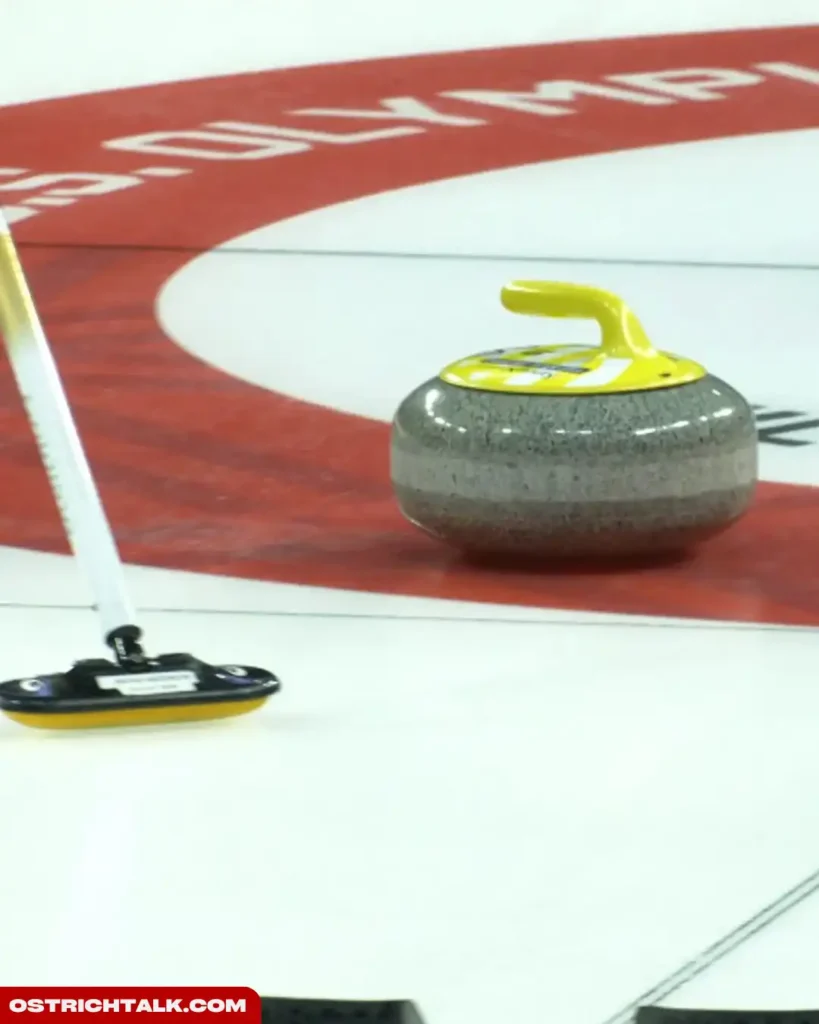
Elite coaches consistently describe curling as a sport where the throw sets the ceiling and the brushes set the floor. A perfectly weighted, well-aimed throw places the stone where the skip envisions it. However, sweeping is the safety net. Moreover, it is also a strategic weapon. Sweepers can extend an under-weighted stone, flatten an over-curling draw, or guide a takeout onto a precise collision angle. According to USA TODAY, with teams alternating eight stones per end across multiple ends, each sweeping decision compounds over the course of a match.
Why Does Ice Condition Change the Brush’s Effectiveness?
Pebble condition deteriorates as a game progresses. Early in a match, fresh pebbles offer more resistance, meaning sweeping generates more heat and has greater effect. Later in the game, worn pebbles reduce the differential between swept and unswept surfaces. Experienced Olympic teams account for this when managing shot selection. A draw shot that runs through clean pebbles may require far less sweeping than the same shot attempted on a deteriorated sheet. Additionally, arena temperature, humidity, and ice maintenance schedules all influence how much a brush can alter the stone’s path at any given moment.
Why Do Brush Regulations Matter for the Integrity of Olympic Curling?
The core principle of curling is that the thrower’s skill determines strategy. Sweeping is a support mechanism, not an override. When broom technology crosses a threshold where sweepers can meaningfully redirect a stone beyond the thrower’s intent, the sport’s competitive balance shifts in ways that officials and athletes alike consider unfair. According to Inside the Games, World Curling has now committed to continuous re-evaluation of sweeping equipment specifications as materials science evolves. Nevertheless, the June 2025 ban demonstrated that governing bodies can act swiftly when athlete consensus demands it. That responsiveness is what keeps Olympic curling credible as a precision sport at the highest level.
Frequently Asked Questions
How do brushes affect the stone’s path in Olympic curling?
Brushes generate friction heat that partially melts the ice surface, reducing friction between the stone and the pebble tops. This causes the stone to travel farther and straighter, and skilled sweepers can also steer its final position by several feet.
Does sweeping make a curling stone go faster?
Sweeping does not increase the stone’s speed. According to Yahoo Sports, it does not slow the stone either. What it does is reduce friction, extending how far the stone travels before stopping.
Can sweepers actually steer a curling stone?
Yes, within limits. By applying more brush pressure to one side of the stone’s path, sweepers reduce friction on that side and cause the stone to drift toward it. Elite teams use this to fine-tune placement even after an imperfect throw.
What is directional sweeping in curling?
Directional sweeping is the technique of angling the brush head and applying pressure asymmetrically to influence the degree of curl. It became controversial in 2015 when new broom technology allowed sweepers to override the thrower’s intended line almost entirely.
What was Broomgate in Olympic curling?
Broomgate was a 2015-16 controversy triggered by stiff synthetic broom pads that let sweepers steer stones like a joystick. More than 50 elite teams boycotted the brooms, and World Curling held a Sweeping Summit in 2016 that resulted in strict uniform brush standards.
Were new brooms banned before the 2026 Olympics?
Yes. In June 2025, World Curling banned high-compression foam brush heads from BalancePlus, Goldline, and Hardline after widespread athlete complaints that they gave sweepers too much control, according to CBC Sports. Compliance checks were active during the Milano-Cortina Games.
How far can sweeping move a curling stone off its natural path?
Research and elite coaching sources consistently cite several feet as the range of influence effective sweeping can achieve. The exact figure depends on ice condition, stone speed, brush pressure, and technique.
Why do Olympic curlers sometimes only use one sweeper?
Recent research supported by World Curling found that the sweeper positioned farther from the stone has significantly lower impact. Some elite teams, including Switzerland’s Team Schwaller, have adopted a one-sweeper model to concentrate force where it is most effective.
What are Olympic curling brooms made of?
According to Yahoo Sports, modern Olympic curling brooms are made from carbon fiber or fiberglass handles with synthetic brush heads that must meet World Curling specifications updated in June 2025. High-compression foams are now banned; only brushes with less-firm foam inserts are approved.
How physically demanding is sweeping in Olympic curling?
Very demanding. Heart rates during intense sweeping sequences regularly exceed 180 beats per minute. Sweepers must drive their body weight through the brush head while maintaining precise stroke rhythm over approximately 90 feet of ice, making it one of the sport’s most underrated athletic skills.
Read about Angel Reese Net Worth
